
EXAMPLES
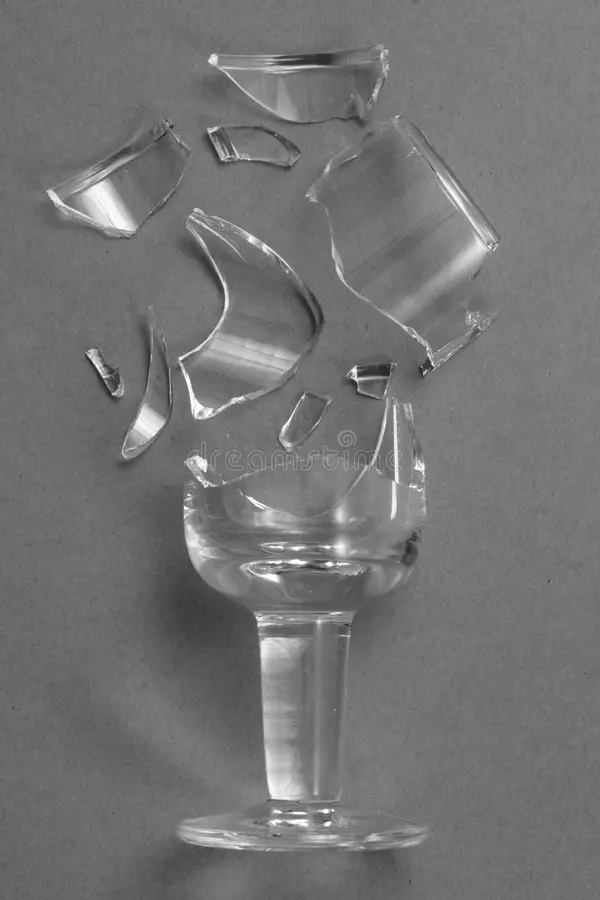
There are several examples where mechanical resonance has shown some surprising and impressive results. One of the simplest examples is that of the opera singer capable of shattering a drinking glass by hitting the proper note. It’s instructive to note that the drinking glass doesn’t shatter by the sheer acoustic force from the singer, but the shattering is due entirely to the singer hitting the exact resonant frequency of the drinking glass and then to hold that note briefly.
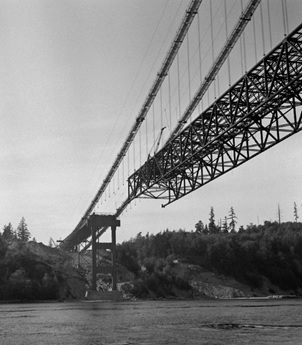
Another display of the power of resonance occurred with the Tacoma Narrows bridge which literally destroyed itself shortly after opening in 1940. Before the official opening the bridge was nicknamed “Gallopin Gertie” due to its unstable nature in the presence of cross-winds which continued until the day of its collapse.
The collapse of the bridge has been an issue that has been debated and analyzed for over 80 years. The University of Washington has even had major studies on the collapse of the bridge and has built scale models of the bridge in an attempt to determine the cause of the bridge failure.
Our analysis of the bridge failure points to its collapse as probably due to the effects of parametric resonance, which is often not even mentioned in a study of the bridge’s design failures. If you look at the following two pictures of the bridge, shortly before its collapse, you can clearly see a mechanical resonance effect, moving as a strong sinusoidal wave, travelling across the bridge in a transverse direction. Later, the resonance effects became stronger and the bridge was shut down before its collapse.
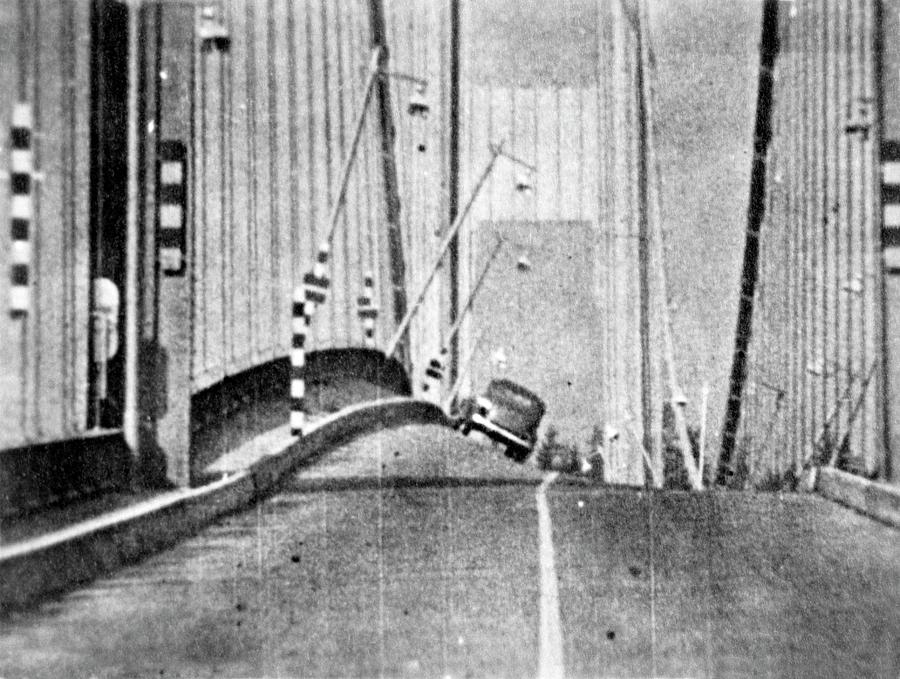
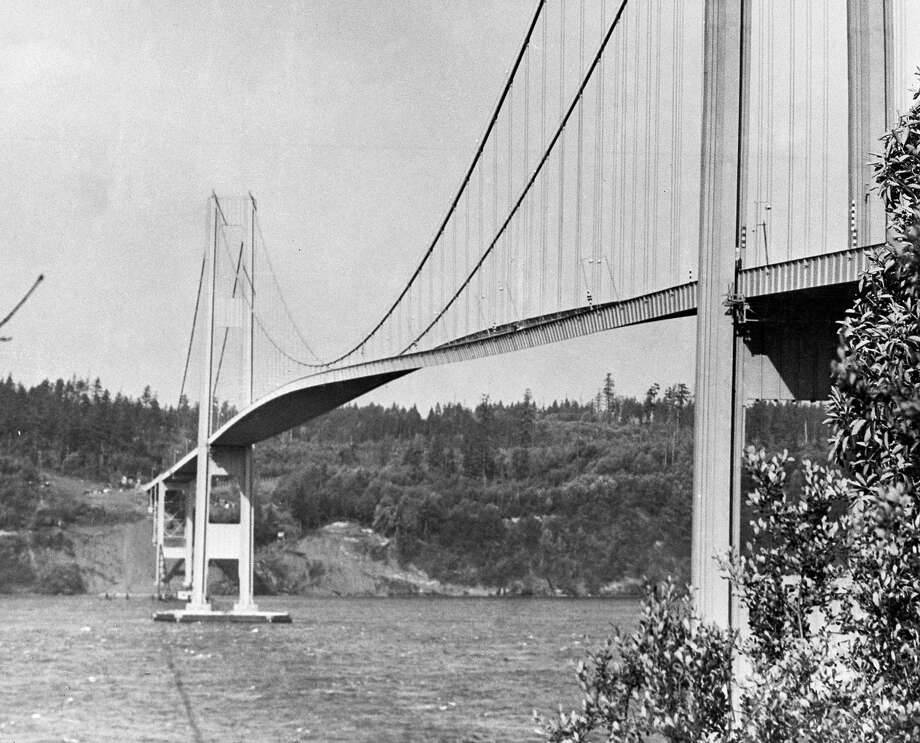
On that day, the winds increased to about 40 mph as a cross-wind coming across the bridge. The National Weather Service states that wind must ordinarily reach at least 45 mph before “slight damage” can occur. So clearly, the force of the wind alone was not the cause of the collapse. The bridge itself was experiencing a severe form of resonance, leading to its disastrous collapse as shown.
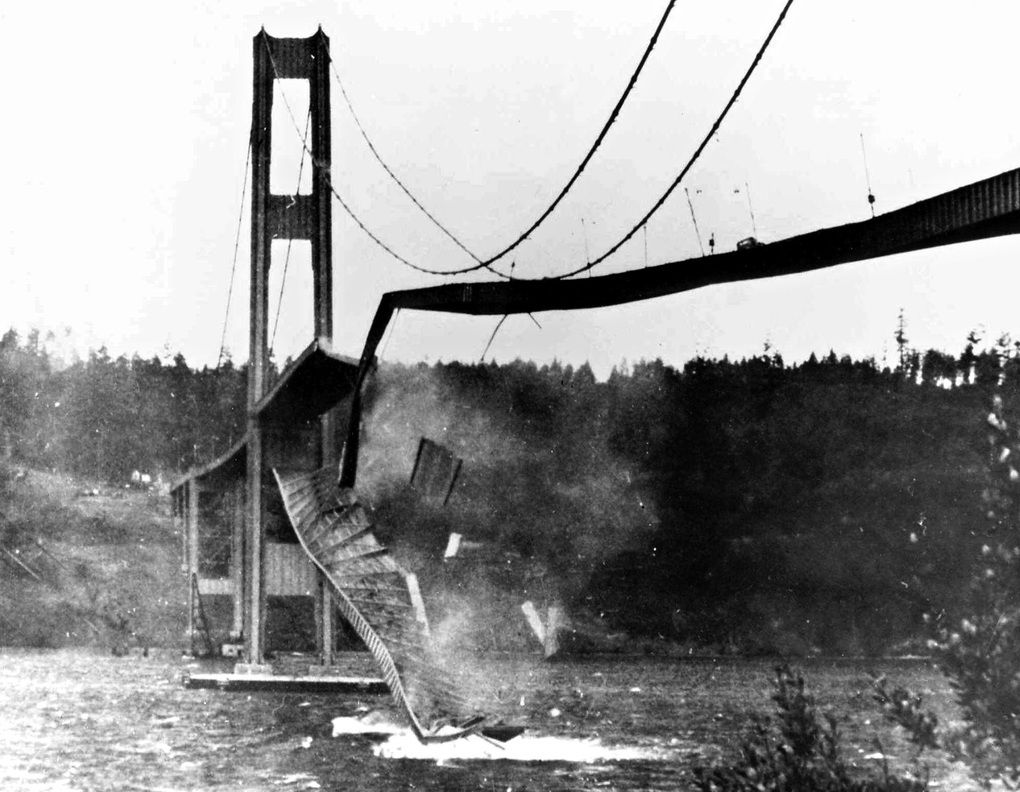
The scenes show an almost textbook case of parametric resonance. The initial resonance is seen as a strong mechanical wave traversing the roadway and crossing in a parallel direction. Later, another wave, moving in a vertical direction can be seen literally ripping the bridge to pieces. The energy seen in the destruction of the bridge could not reasonably be attributed to some sort of expected mechanical resonance.
However, parametric resonance provides a method for energy to be pumped into the bridge at an exponential rate, which conforms to our observation of the massive amount of energy released when the bridge collapsed.
Parametric resonance for this mechanical system begins at a fundamental frequency, which we do see moving transversely across the bridge. Later, we see a second wave moving vertically at a higher frequency but having a massive amplitude, literally ripping the bridge apart. If the second frequency is very close to twice the original frequency, then parametric resonance will allow energy to be pumped into the bridge at an exponential rate. This would appear to be the only physical argument that could explain how the bridge could absorb such a massive amount of energy. Many of the proposed mechanisms offered over the last 80 years don’t really explain how such a massive amount of energy could be delivered to the bridge from a 40 mph cross-wind. It appears that only those mechanisms that include parametric resonance could explain the observed results.
The classic parametric resonance can be observed in a system like the bridge by observing the transverse wave at frequency F1, with another frequency very near to twice F1. The first frequency in a static mechanical system, like the bridge, would be generated through a mechanical object having a length of L. The second resonance would then have a mechanical length of approximately half that of L, providing a method of pumping energy into the bridge at an exponential rate. This gives us a clue to look for in finding the “smoking gun” explaining the disastrous collapse of the bridge.
The following picture shows the wreckage of the bridge with one of the road supports visible. This allows us to see the width of the underlying bridge support and the approximate height of the bridge support structure at about half the width of the bridge support. This defines a classic parametric resonance relationship with the two frequencies at a 2-to-1 relationship with energy initially available at the first, lowest, frequency. It also needs to be pointed out that the bridge support, normally not seen, along with the concrete and asphalt of the bridge has been completely ripped away from the support structure, showing the tremendous energy that was developed within the bridge structure, all probably done through parametric resonance and not the simple resonance, or “flutter”, often given as the cause of the bridge collapse.
In addition, sonic resonance has shown itself to be useful in performing lithotripsy in which kidney stones and gall stones have been destroyed through the application of sonic shockwaves. This shows that a wide range of control over virtually any object can be achieved from an understanding of the structure, environment and resonance of the object.
EXAMPLES
^^^^^^^^^^^^^^^^^^^^^^^^^^^^^^^^^^^^^^^^^^^^^^^^^^^^^^^^^^^^^^^^^^^^^^^^^^^^^^^^^
 Gun Stopper